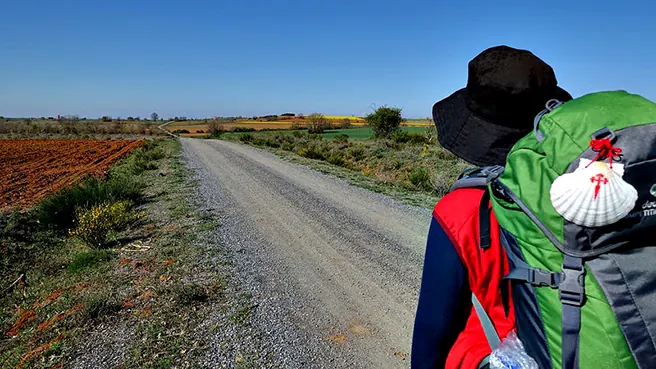
Guided vs self-guided Camino: self-guided is the standard format for an organized Camino, and the right fit if you want to walk on your own schedule. You pick the dates, you set the pace, and the agency handles the beds, the luggage and the credential. A guided group, walking with a guide on a fixed-date departure, makes sense when you're bringing a whole group with you: a school, a parish, a company or an association. And going fully independent, booking everything yourself, is the cheapest way to walk the Camino and still a great choice for plenty of pilgrims.
We're Ourway, a local agency with our office in Palas de Rei, right on the home stretch of the Camino Francés. We sell organized Caminos, so we're not entirely neutral. What we can give you is an honest comparison of the three ways to do it, including the cases where we'd tell you not to hire anyone at all, us included.
The short answer
- Self-guided: the standard. Your dates, your pace, logistics handled. Best if you have fixed dates, want a private room, or simply don't have the hours to piece the trip together.
- Guided group: for organized groups who want to walk together, with a guide, luggage and a support van included, on a fixed-date departure.
- Independent: the cheapest and the most flexible. Best for classic pilgrim budgets, off-season walkers with flexible dates, and people who've done the Camino before.
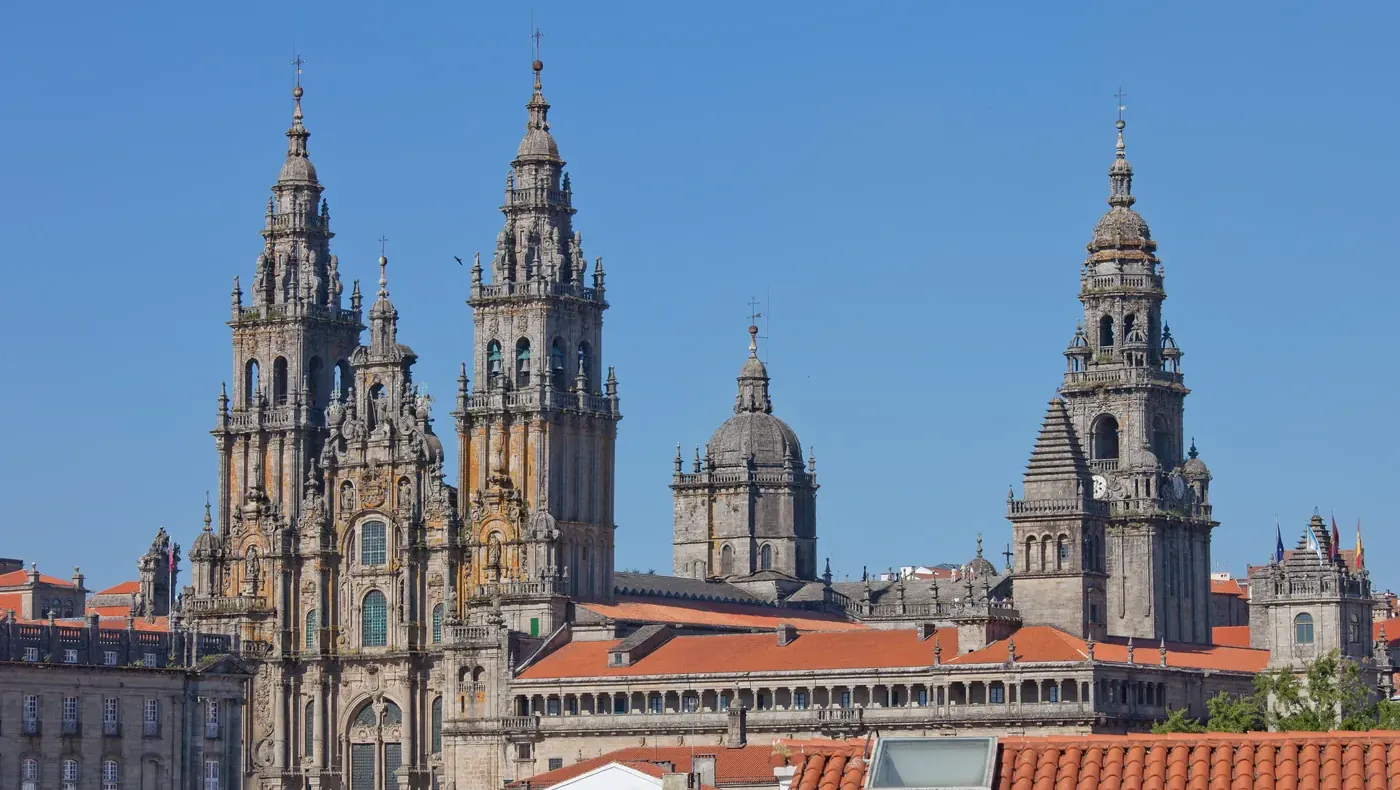
All three end in the Obradoiro in Santiago. The difference is what you carry yourself and what you hand off.
The three ways to walk the Camino, explained
Guided: walking with a guide and a group
In the U.S., a "guided" trip usually means you walk with a guide and a group, on fixed departures. That's how we run guided Caminos too, in two forms: trips built for groups such as schools, parishes, companies and associations, and open fixed-date departures that anyone can join, whether you're traveling solo, as a couple or with friends. Accommodation, luggage, a guide and a support van are all included. We offer fixed-date departures, and every group gets its own custom quote.
The appeal is easy to see: the group walks together, with a guide alongside, luggage and a support van included, and nobody has to chase bookings for everyone else. The trade-off is just as clear: you walk on the group's dates, not your own.
Self-guided: your Camino, our logistics
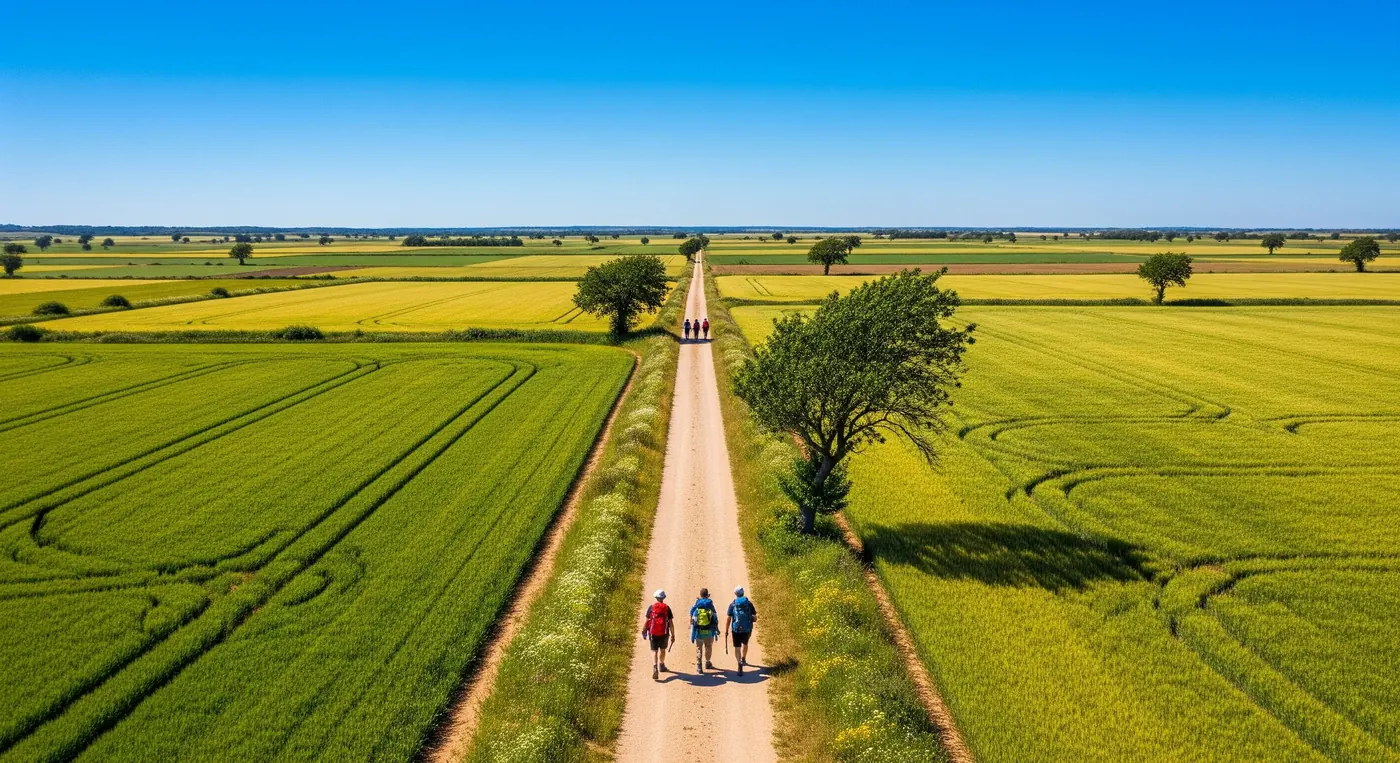
Here's the most common misunderstanding about organized Caminos: people picture a bus with a guide holding up a little flag. That's not what an organized Camino is, unless you ask for it. The standard format is self-guided. You walk on your own, at your own pace, on the official route, with the yellow arrows as your guide, and the agency takes care of the logistics. In practice, that means:
- An itinerary built around you. How many stages, how long each one is, and where you start, adjusted to your vacation days and your fitness, on foot or by bike.
- Your beds booked night by night. This is the bulk of the work. It's a chain of nights in small towns with a limited number of beds, and if one night falls through, it drags the rest down with it.
- Luggage transfer, stage by stage. Your suitcase travels by road from one place to the next while you walk with a small daypack. It's the service that has saved more Caminos than any other.
- Transfers that public transport doesn't cover, such as from the airport to your starting point or back from Santiago.
- Your credential, the pilgrim passport, delivered before the first stage, with clear instructions for getting it stamped: two stamps a day if you start within the last 100 km, as you do from Sarria.
- Help while you walk. A phone that someone answers if tendinitis forces you to cut a stage short, if you miss a connection, or if a night has to be moved on the fly.
Some people need a fully custom Camino: dates outside the usual calendar, half stages, extra nights in Santiago, or a pet along for the walk.
Independent: you book everything yourself
Fully independent means exactly that. You choose the stages, you find the beds, you carry your pack or arrange your own luggage transfer, and you decide on the go where to stop. At its most classic, it's a bunk in a public albergue, your backpack on your shoulders and zero reservations. That's partly by necessity: the public albergues run by the Xunta don't take reservations at all.
Guided vs self-guided vs independent at a glance
| Guided group | Self-guided | Independent | |
|---|---|---|---|
| Who books | The agency, for the whole group | The agency, night by night | You |
| Dates | Fixed-date departures | Yours, fitted to your vacation days | Yours, and you can change them on the go |
| Pace | The group walks together | Your own, but each night has a set destination | Your own, and you decide where to stop as you go |
| Company | Your group plus a guide | Just you and whoever you bring | Just you and whoever you bring |
| Luggage | Included, with a support van | Moved for you at every stage | On your back, unless you arrange it |
| Prep time | Handled for the group: lodging, luggage, guide and van included | Picking your dates and not much else | Hours of comparing, booking and making the distances work |
| High-season risk | Low: accommodation is included | Low: your bed is guaranteed | Real: full houses, early starts to grab a bunk, extra miles looking for a bed |
| Cost | Custom quote for each group | Higher than going solo; our package starts from €410 per person | Can be minimal: public albergue and pilgrim's menu |
When going independent is the better choice
This is the part most agencies don't write. For some pilgrims, paying for an organized trip, guided or self-guided, simply doesn't make sense:
- You're on a classic pilgrim budget. A bunk in a public albergue, your pack on your back and no reservations. It's the cheapest way to walk the Camino, and it has a charm of its own that no package can replicate.
- You're going in the low season with flexible dates. Outside the busy months, there are almost always beds to spare, so the main argument for an organized trip, the guaranteed bed, carries much less weight. Our guide to the best time to walk the Camino goes month by month.
- You've done this before. If you already have two or three Caminos behind you, you know your distances, and you actually enjoy sorting out the logistics, you probably don't need us.
- Not knowing is the point. Some people want exactly that: no idea where they'll sleep tonight. We respect that one hundred percent.
When self-guided pays off
Now the other side. Self-guided earns its price in a handful of very specific situations:
- You're walking between May and October on fixed dates. Your flights are bought, your vacation days are counted, and you can't afford to lose an afternoon hunting for a bed.
- You're traveling with your partner, your family or your friends, and a private room with a bathroom is non-negotiable. Those are the rooms that sell out first all along the Camino.
- You don't have the hours to build the chain of reservations, or any desire to chase down confirmations.
- It's your first Camino and you'd rather start with a safety net: an itinerary that works, luggage sorted, and a phone number to call.
If you've flown across an ocean for a set number of days, that first point is the big one. Sarria is the most popular starting point on any Camino, and our guide to walking the last 100 km from Sarria explains how that week fits together. If you're flying in, we can also handle the transfer from the airport to your starting point.
When a guided group makes sense
Self-guided is the standard, but it isn't for everyone. Guided group trips exist as a separate product, designed for people who would rather have organized company on the trail.
You don't need to bring your own group. Our open departures on the French Way from Sarria (6 nights) are led by an Ourway guide who speaks Spanish and English, and they're guaranteed to run. You pick a date, book online and your place is confirmed instantly, with selected accommodation and breakfast included every night. If you're traveling solo or as a couple and the idea of company on the trail appeals, this is the guided option built for you.
Where it really shines is with groups that already exist: a school trip, a parish pilgrimage, a company outing or an association that wants to walk together. With a guide, luggage, a support van and accommodation for everyone handled in one go, the people organizing the trip don't end up as its unpaid travel agents. If that's you, take a look at our Camino group trips and ask for a quote for your group.
What it costs
We won't give you a table of market prices for organized Caminos, because any average figure would be made up. The price moves with five things, worth knowing so you can compare quotes properly: the number of stages (the biggest factor), the category of lodging, the type of room (a shared double is always the most affordable per person), the season, and extras such as private transfers, extra nights in Santiago or half stages.
Here's a real reference you can check for yourself: our self-guided French Way from Sarria package, covering the last 100 km from the most popular starting point on any Camino, starts from €410 per person. That includes accommodation for the whole itinerary, luggage transfer at every stage, your credential and local assistance. Every extra comfort adds from there.
Going independent can cost far less, especially if you sleep in public albergues. For the full budget line by line, organized and on your own, read how much the Camino de Santiago costs.
How to choose a Camino company
Four checks separate the serious operators from the pretty photos:
- Ask for the travel agency license. In Spain, selling a package trip requires a license, and that license protects you legally: the agency is responsible for the package as a whole, and you have guarantees if something goes wrong. It should be visible on the website. If it isn't, ask. If they don't answer, walk away. Ours, for the record, is XG-LU-000236.
- Tell a local team from a reseller. Plenty of the websites selling the Camino work from offices that have never set foot on it, reselling packages put together by someone else. Ask where they work from, who will answer if something goes wrong halfway through a stage, and whether they know the places they book from more than a photo.
- Call them before you book. This is the real test. If all you can find before paying is a contact form and a chatbot, imagine what it's like afterward. 24/7 assistance only counts if there's a number a real person picks up.
- Get the details before you pay. Which places you'll be staying (or at the very least their category and exact location), which transfers are included, and what happens if you need to cancel or change dates. All of it in writing.
Red flags
- A price strikingly lower than everyone else's with no word on where you'll sleep.
- No license and no physical address anywhere on the website.
- "24/7 assistance" with no phone number behind it. Scratch the surface and the promise turns out to be an email address.
- Basic mistakes about the Camino itself: distances that don't add up, or promising you the Compostela without mentioning the real minimums (100 km on foot, 200 km by bike) or the daily stamps on your credential.
- Full payment up front, by bank transfer, with no contract and no terms and conditions.
None of these on its own condemns anyone. Two or three together do.
Frequently asked questions
What's the difference between a guided and a self-guided Camino?
On a guided Camino you walk with a guide and a group on a fixed-date departure; on a self-guided Camino you walk on your own dates and at your own pace while the agency handles the logistics. In both cases your accommodation and luggage are taken care of. The real difference is whether you want company on the trail and a set departure, or the freedom of your own calendar.
Do Camino tour companies include a guide?
Not by default: the standard format is self-guided, so you walk on your own with the logistics handled and the yellow arrows as your guide. Group trips with a guide exist as a separate product, designed for people who prefer organized company. Ours come in two forms: trips built for groups such as schools, parishes, companies and associations, and open fixed-date departures led by an Ourway guide that you can join on your own or as a couple.
Is it better to walk the Camino independently or with a company?
Neither is better in the abstract. Going independent wins on price and on the freedom to improvise; going organized wins on prep time and a guaranteed bed. With fixed dates between May and October, organized pays off almost every time. In the low season, on a minimal budget or with Caminos already behind you, going independent is a great option.
How much does a self-guided Camino cost?
It depends on the number of stages, the category of lodging, the type of room and the season. As a reference, our self-guided package for the last 100 km from Sarria starts from €410 per person. The full budget breakdown is in our guide to how much the Camino costs, linked above.
If you read all this and decide to go independent, buen Camino. We mean that. And if you'd rather leave home with your beds lined up and your luggage sorted, or you're organizing a group, write to us. We answer from an office that sits, quite literally, on the Camino.
Ourway Travel, licensed travel agency XG-LU-000236. Palas de Rei, Galicia, on the Camino Francés.