
Tui is to the Camino Portugués what Sarria is to the Camino Francés: the place you start if you want the last 100 kilometers and the Compostela at the end of them. It is the first Spanish city on the Central route of the Camino Portugués, sitting on the Miño directly across from Portugal, about 115 kilometers from the cathedral in Santiago. (If it is the Francés you are weighing up, we have written that walk up too: Sarria to Santiago, the last 100 km.)
This is a planning guide to those last 115.8 km — 72 miles — split into six days. One thing up front, since it affects how much weight to give to what follows: our office is in Palas de Rei, which sits on the Camino Francés, not on this route. We are not going to tell you that you will walk past our door. What is true is that every mile described below runs through Galicia, which is where we live and work, and that we operate this route with our own team on the ground. We will write "day" rather than "stage" throughout, because that is how the walk actually feels once you are in it.
Does starting in Tui count for the Compostela?
Yes, with margin. The cathedral in Santiago issues the Compostela to pilgrims who can show they walked the last 100 km on foot. From Tui you walk 115.8 km, which leaves you almost 10 miles (15.8 km) of slack instead of sitting on the line. A detour, a wrong turn or a rerouted afternoon never puts the certificate at risk.
The paperwork is simple. You carry a credential — the pilgrim passport — and you get it stamped as you go. Over the last 100 km the requirement is two stamps per day, not one. Our advice to every client is to stop calculating which day technically falls inside the 100 km and just collect two stamps a day from Tui onward. Stamping is part of the culture of the Camino and asking for one is never an imposition; the place you sleep each night can stamp your credential, and Tui's cathedral is the natural place for your first.
Is it cheating to start in Tui?
You will run into this attitude online, usually from someone who walked from Lisbon, so it is worth answering directly. The cathedral's criterion is the last 100 km on foot. From Tui that is 115.8 km, and the question is settled. Tui is to the Portugués what Sarria is to the Francés — the natural place to pick up the final stretch — and there are pilgrims who have walked both endings and prefer this one. Six days on foot across Galicia are six days on foot across Galicia. Walk it and let the argument go.
The six days at a glance
| Day | Route | Miles | Kilometers | Approx. walking time |
|---|---|---|---|---|
| 1 | Tui to O Porriño | 10.0 mi | 16.1 km | about 4 hours |
| 2 | O Porriño to Redondela | 9.8 mi | 15.8 km | just under 4 hours |
| 3 | Redondela to Pontevedra | 11.8 mi | 19.0 km | about 4 hours 45 minutes |
| 4 | Pontevedra to Caldas de Reis | 13.1 mi | 21.1 km | about 5 hours 15 minutes |
| 5 | Caldas de Reis to Padrón | 11.6 mi | 18.6 km | about 4 hours 40 minutes |
| 6 | Padrón to Santiago | 15.7 mi | 25.2 km | about 6 hours 15 minutes |
| Total | 72 mi | 115.8 km |
Those walking times are arithmetic, not measurements. We divided each distance by a steady pilgrim pace of about 2.5 mph (4 km/h) and rounded. They leave out coffee, photographs, the stamp you stop for, and the long lunch you will eventually stop resisting. Real days run considerably longer than the column above, and that is normal.
Day by day, Tui to Santiago
Day 1 — Tui to O Porriño · 10.0 mi (16.1 km)
Tui is a serious place to begin. The Catedral de Santa María sits above the town like a fortress, Romanesque turning gothic, and the old quarter below it is a designated historic district — narrow stone lanes, convents, the Clarisas tunnel, named for the Poor Clares. Get your credential stamped there and walk out with the first mark in it.
The day itself is the second-shortest of the six and deliberately gentle: your body is still on U.S. time and your pack still feels wrong. Be aware that this stretch has a reputation. For years the approach to O Porriño ran through an industrial park, and that complaint still circulates in guidebooks written from memory. The route now uses a riverside path along the Louro instead, which makes the walk far more pleasant than its reputation suggests. O Porriño itself is a working granite town — the pink stone quarried here, Rosa Porriño, is shipped worldwide — with a landmark town hall by the architect Antonio Palacios and plenty of places to eat and sleep. A functional first night, and there is nothing wrong with that.
Tui to O Porriño: route detail and where to sleep
Day 2 — O Porriño to Redondela · 9.8 mi (15.8 km)
The shortest day of the six, and the one where the landscape starts doing the work for you. The country rolls and opens up, and you come down into Redondela with the Ría de Vigo in front of you: this is coastal Galicia, which most first-timers don't expect from a Camino. You will recognize the town from a distance by its two historic railway viaducts crossing the sky above it.
Redondela is also the junction. This is where the Coastal route merges back into the Central, so from this afternoon on you are walking the same path as everyone who came up the coast. The old quarter, with the church of Santiago at its center, is a good place to eat and to compare notes with pilgrims who started a long way further south.
O Porriño to Redondela: stage map and lodging
Day 3 — Redondela to Pontevedra · 11.8 mi (19.0 km)
Distances start climbing here, and so does the quality of the day. You leave Redondela, which sits between the sea and the hills, and you finish in the best town on the route — and we will defend that.
Pontevedra is the capital of the Rías Baixas, and its pedestrian old town is exceptionally well preserved: a maze of squares and paved streets full of terraces and coats of arms. The city has won international awards for building itself around people rather than cars, which you feel immediately in your feet. The church that belongs to the Camino here is the Santuario de la Virgen Peregrina, built on a floorplan shaped like a scallop shell; the Basílica de Santa María la Mayor, with its plateresque facade, is the other one to walk to. If you have a seventh day to spend and you are wondering where to spend it, spend it here. The Plaza de la Leña, the Plaza de la Verdura, the banks of the Lérez, an unhurried afternoon.
Redondela to Pontevedra: the day in detail, plus where to stay
Day 4 — Pontevedra to Caldas de Reis · 13.1 mi (21.1 km)
The second-longest day, and the one your legs will remember. It ends in a hot-springs town, which is the best news your feet will get all week. Caldas de Reis has been known for its thermal water since Roman times; the public fountains at As Burgas run at over 104°F (40°C), and soaking your feet in one at the end of a 13-mile day is therapy. The town sits on the Umia, with medieval bridges and a botanical garden, and it has spas, albergues and restaurants.
If you build one genuinely slow evening into this trip, make it this one. Arrive early, get in the water, eat well, sleep hard.
Pontevedra to Caldas de Reis: route map and lodging
Day 5 — Caldas de Reis to Padrón · 11.6 mi (18.6 km)
A moderate day into a small town that the whole tradition rests on. Legend holds that the stone boat carrying the Apostle James back from Palestine tied up here, at what was then Iria Flavia. The mooring stone — the pedrón that gives the town its name — is kept beneath the high altar of the church of Santiago, and it is the one thing to see before you leave.
Padrón is literary Galicia too: Rosalía de Castro and Camilo José Cela both came from here, and the riverside walk along the Sar is a pleasant one. It also gave its name to the peppers, whose local motto — uns pican e outros non, some are hot and some aren't — is the only warning you will get. Last night before the cathedral. Use it.
Caldas de Reis to Padrón: the stage in detail
Day 6 — Padrón to Santiago · 15.7 mi (25.2 km)
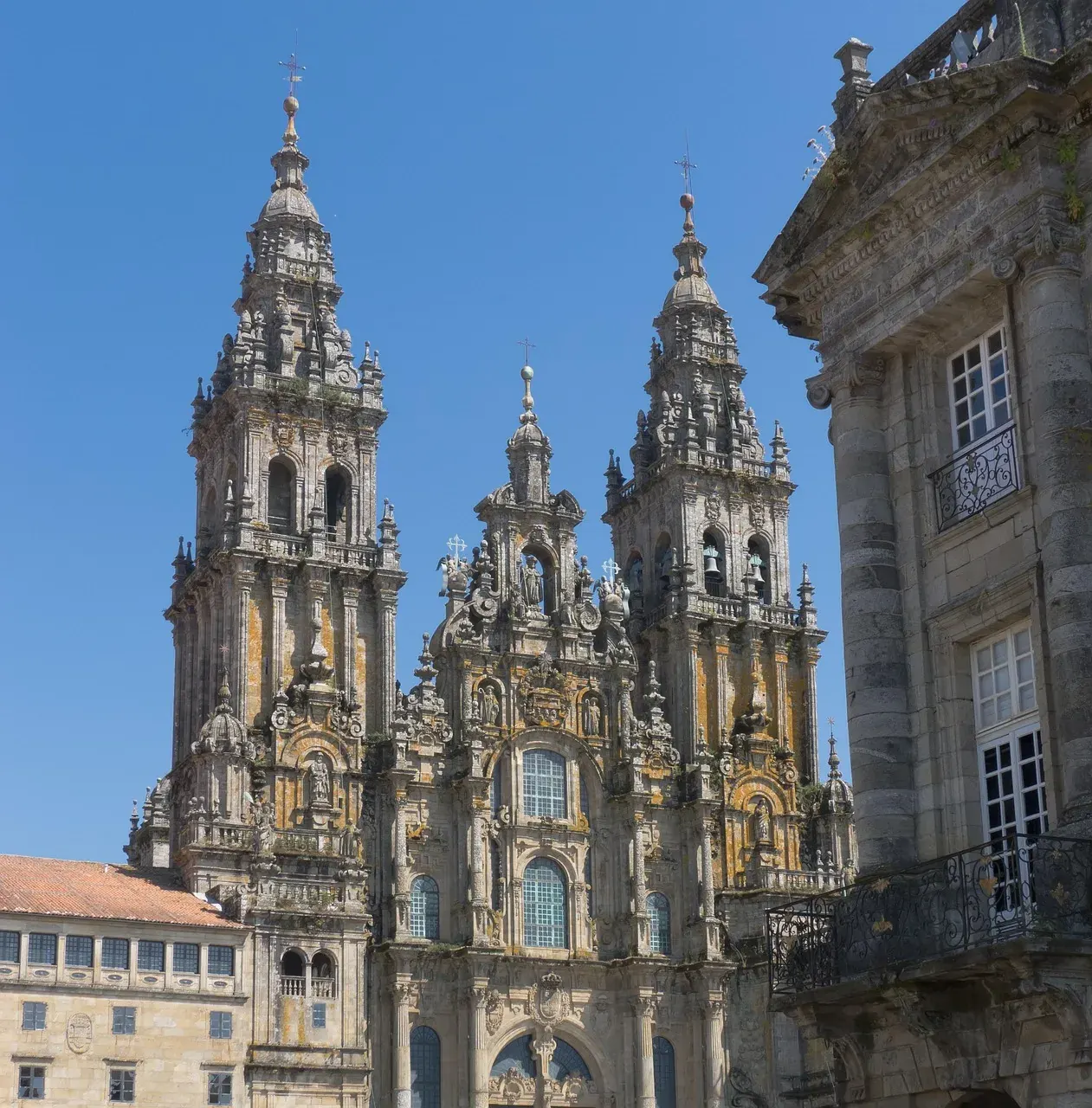
The longest day, by a margin, on legs that have already covered 56 miles. Start early. On the approach you reach O Milladoiro, whose name comes from humilladoiro — the place where pilgrims knelt when the cathedral towers first came into view. Then the outskirts, then the old town, then the Plaza del Obradoiro, and whatever it is that happens to people there.
You can split this day in two: Padrón to O Milladoiro is 11.3 mi (18.2 km), and O Milladoiro to Santiago finishes the job the next morning. We recommend this a lot. It turns the last day into a short, unhurried walk into the city with the whole afternoon free for the Pilgrim's Office, the cathedral, the crypt, and the Pilgrim's Mass, where a giant censer called the Botafumeiro flies over the nave.
Padrón to Santiago: the full 15.7 miles, with the O Milladoiro split marked
Portugués or Francés? Central or Coastal?
How it compares with the Camino Francés
People usually frame this as a scenery question. It isn't. The difference pilgrims who have walked both keep pointing to is social: the Francés has a density of company that the Portugués doesn't. Conversations start on the trail because everyone is going the same way at the same speed. On the Portugués, more people walk head-down.
Here is our version. Choose the Francés if community is the point: if you want to eat dinner with the same eleven people four nights running and arrive in Santiago with a group. Choose the Portugués from Tui if the estuaries and the towns on this route are what appeal to you, and if you want a walk that leaves you more room to be alone in your own head. If you want to see how the other one reads, we have written the same guide for the Francés: Sarria to Santiago, the last 100 km.
Central or Coastal — and why the question dissolves at Tui
This is the most common confusion we field, so: if you start in Tui, you are on the Central route by definition. The Central and the Coastal are genuinely different walks further south, but they converge at Redondela on your Day 2, and from there to Santiago they are one path. There is no decision left to make.
If you want to build something different — extra nights, a rest day, a different starting point on either route — that is a conversation rather than a menu. Write to us with your dates and we will tell you what fits, and say so plainly when something doesn't.
When to walk, and what 2027 changes
April through October is the usual walking window in Galicia. Then there is the calendar. 2027 is a Holy Year — a Xacobeo — because July 25 falls on a Sunday. The Holy Door opens on the afternoon of December 31, 2026 and stays open through the whole of 2027. The last one was 2021 and the next is 2032. We have written up what a Holy Year actually involves here: the 2027 Holy Year on the Camino de Santiago.
What it means for this route is specific. For April to October 2027, book six to twelve months out. Beds along this corridor are finite, and for scale: 2024 brought close to half a million pilgrims to Santiago without being a Holy Year at all.
What we handle
Ourway Travel is a licensed Galician agency (license XG-LU-000236), based in Palas de Rei. We answer the phone in English. On this route we arrange the whole trip: lodging with breakfast, luggage transfer of one bag per person up to 33 lb (15 kg), your credential, a phone number that answers 24 hours a day while you are walking, and Aon Schengen travel insurance covering €30,000 in overseas medical expenses plus repatriation — which is not boilerplate, since most U.S. health plans don't cover you in Spain.
The real argument for booking an itinerary rather than winging it isn't the fear of finding no bed. It is the opposite failure: booking your own rooms too optimistically and then being chained to a 15.7-mile day in August heat because that is where your reservation is. Getting the day lengths right for the specific body doing the walking is most of the job.
If you want your own version — extra nights, a rest day in Pontevedra, the last day split — build it here: design your own Camino. Or just write to us with your dates.
Frequently asked questions
How fit do I need to be?
Fit enough to walk between 9.8 and 15.7 miles (15.8 to 25.2 km) on six consecutive days. There are no technical sections and no scrambling. Train by walking real distances in the shoes you will actually wear, already broken in, rather than on a treadmill in something new.
Do I need to book lodging in advance?
In high season, yes. We reserve private lodging with breakfast for every night of the itinerary, which is the piece that most needs locking in before you fly.
How do I get to Tui?
Tui sits on the Spanish side of the Miño, right on the border, and you can reach it by road or rail from either Portugal or Galicia. Schedules and fares move around, so we send current options once your dates are fixed. One piece of advice from experience: don't plan to take a late connection on the day you land from the U.S. Jet lag plus an arrival after dark in an unfamiliar town is a rough start.
Do I walk in Portugal on this itinerary?
No. Tui is the first Spanish city on the Central route — it faces the Portuguese town of Valença across the Miño — and everything from there to Santiago is in Galicia, in Spain. If you start in Tui, the whole walk is on the Spanish side.
Do I need to speak Portuguese?
Not for this itinerary. Tui to Santiago is entirely within Galicia, in Spain. A few words of Spanish help outside the cities, where English is thinner. You will also see and hear Galician, which is a language in its own right, not a misspelling of Spanish. Learn bo camiño — the Galician form of buen camino — and use it. It is what people say to you on the path.
What documents does an American need for Spain?
Entry rules change, and anything we printed today could be out of date by the time you fly. Check the official EU and Spanish government sources close to your travel dates, and be skeptical of any website that charges you a fee to "process" an EU travel authorization on your behalf.
Where do I get the credential?
The credential is included in the trip we organize, so if you book with us it is handled before you arrive. Your first stamp is Tui's cathedral, and from there you are collecting two a day.
What do I need to pack?
Not much, especially with luggage transfer carrying the heavy bag — one bag per person, up to 33 lb (15 kg). We have written it out properly here: the Camino de Santiago packing list.
How much time do I need in Santiago at the end?
More than you are planning. The Pilgrim's Office is where the Compostela is issued, and collecting it, seeing the cathedral and the crypt, and getting to the Pilgrim's Mass do not fit into the hour after you walk in. Book the extra night in Santiago and don't take a midday flight the day you arrive.
If you'd rather we handled the logistics, take a look at our organized trip from Tui, or the seven-night version with stays at Paradores.