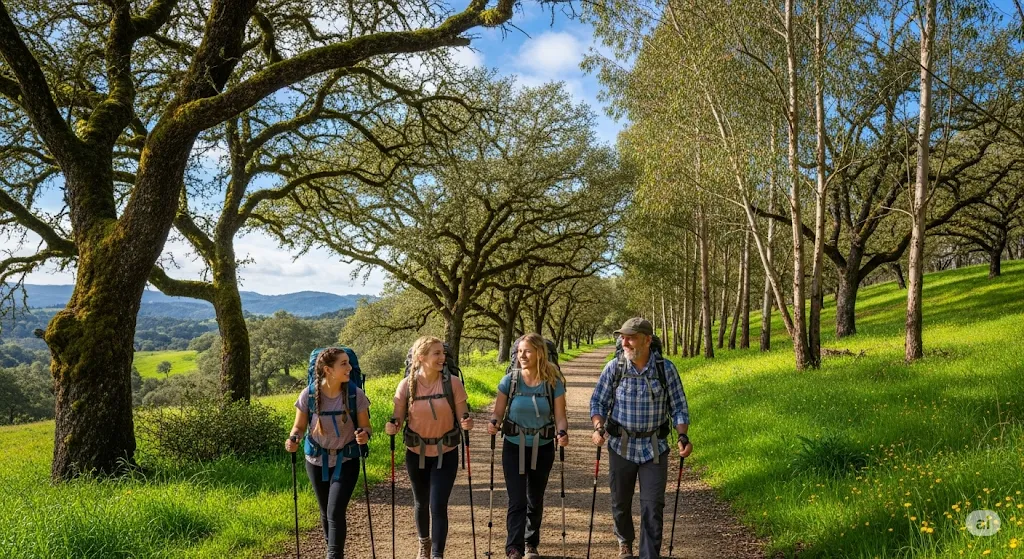
It's 24.8 km from Portomarín to Palas de Rei: stage 30 of the 33 on the Camino Francés, and the second day's walking for anyone who starts in Sarria. It opens with the longest climb of the final 100 km, crosses a stretch with very few services and hides an archaeological detour that hardly anyone makes — and which is the best thing about the whole day.
Here is the stage in full: the real profile, village by village, where to stop and what you'll find when you reach Palas de Rei — which happens to be where our office is, so this is a stretch we know inside out.
The stage in numbers
| Distance | Walking time | Difficulty | Highest point | The detail that really matters |
|---|---|---|---|---|
| 24.8 km | between 5 hr 45 min and 7 hr, depending on your pace and how often you stop | moderate. Nothing technical, but the climb in the first third and the sheer length of the day both make themselves felt | the Serra de Ligonde, around 720 m, between Ventas de Narón and Ligonde | services are thin on the ground until Gonzar (km 8). Have a proper breakfast in Portomarín and set off with water in your pack |
Map, elevation profile and accommodation for this stage →
What the profile looks like: the morning climbs
Portomarín sits at around 350 m, beside the Belesar reservoir. Palas de Rei is at roughly 565 m. In between, the Camino works its way up to the Serra de Ligonde, which tops out at about 720 m. In plain terms: the first half of the stage is an almost continuous ascent — gentle for the most part, with one or two genuinely steep pulls as you leave Portomarín — while the second half is a constant up and down, a textbook rompepiernas, or leg-breaker.
Don't let that put you off: it is the longest climb of the final 100 km, but nowhere near the hardest on the Camino. Spread over 13 km, with oak shade and wide tracks, it is easier going than it sounds. The trick is pacing yourself: pilgrims who charge out of Portomarín tend to pay for it on the closing rollercoaster.
The route, village by village
Portomarín – Gonzar (km 0 – 8)
You leave Portomarín by crossing the Miño once more and gaining height through pine and oak, on a section that runs close to the road for a while. This is the loneliest part of the day: for almost 8 km there is very little in the way of places to stop, so it pays to have breakfast sorted before you go. Gonzar, the first village with any services, is the natural place for that first coffee.
Castromaior and its castro: the detour hardly anyone makes (km 9)
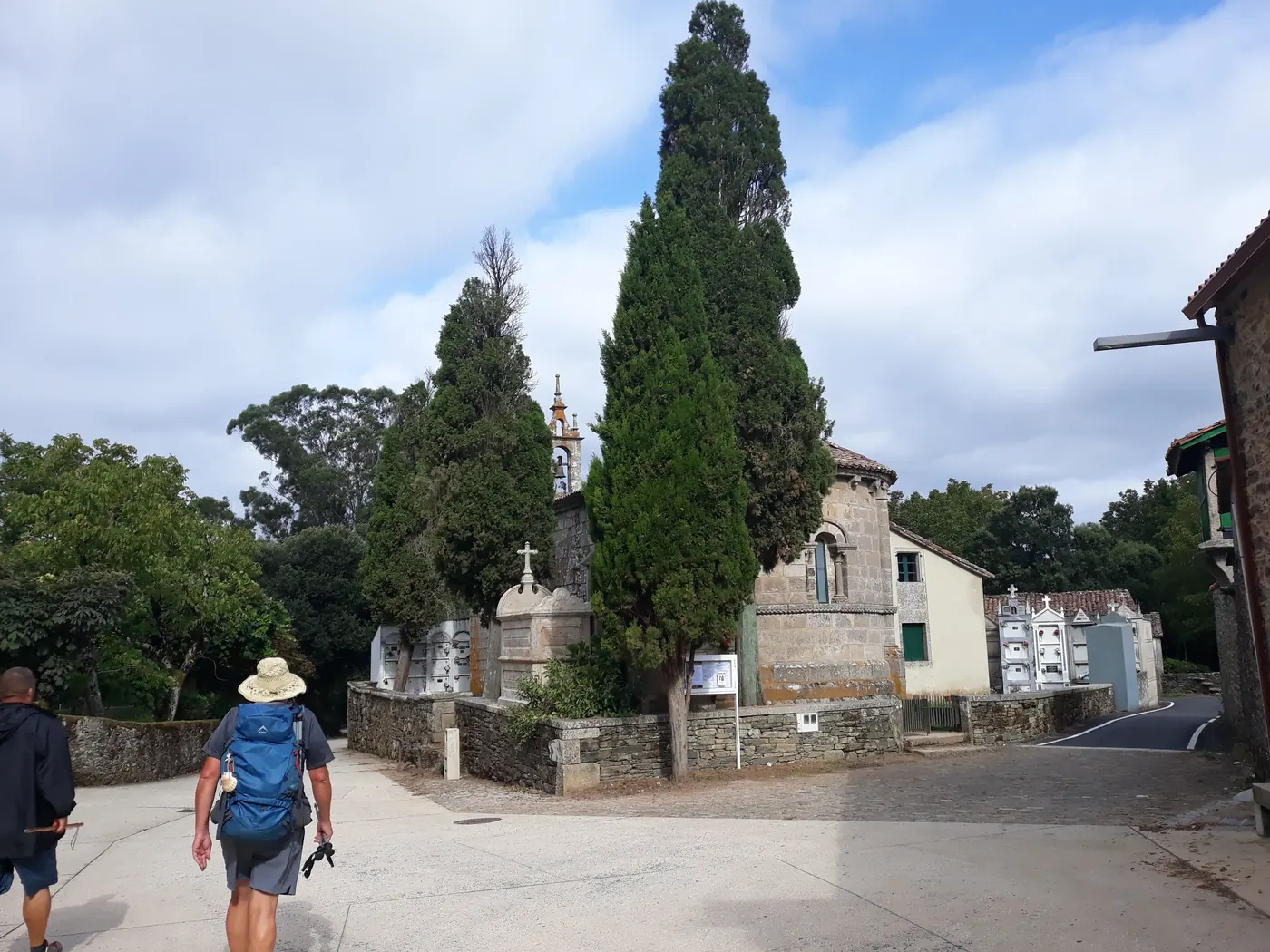
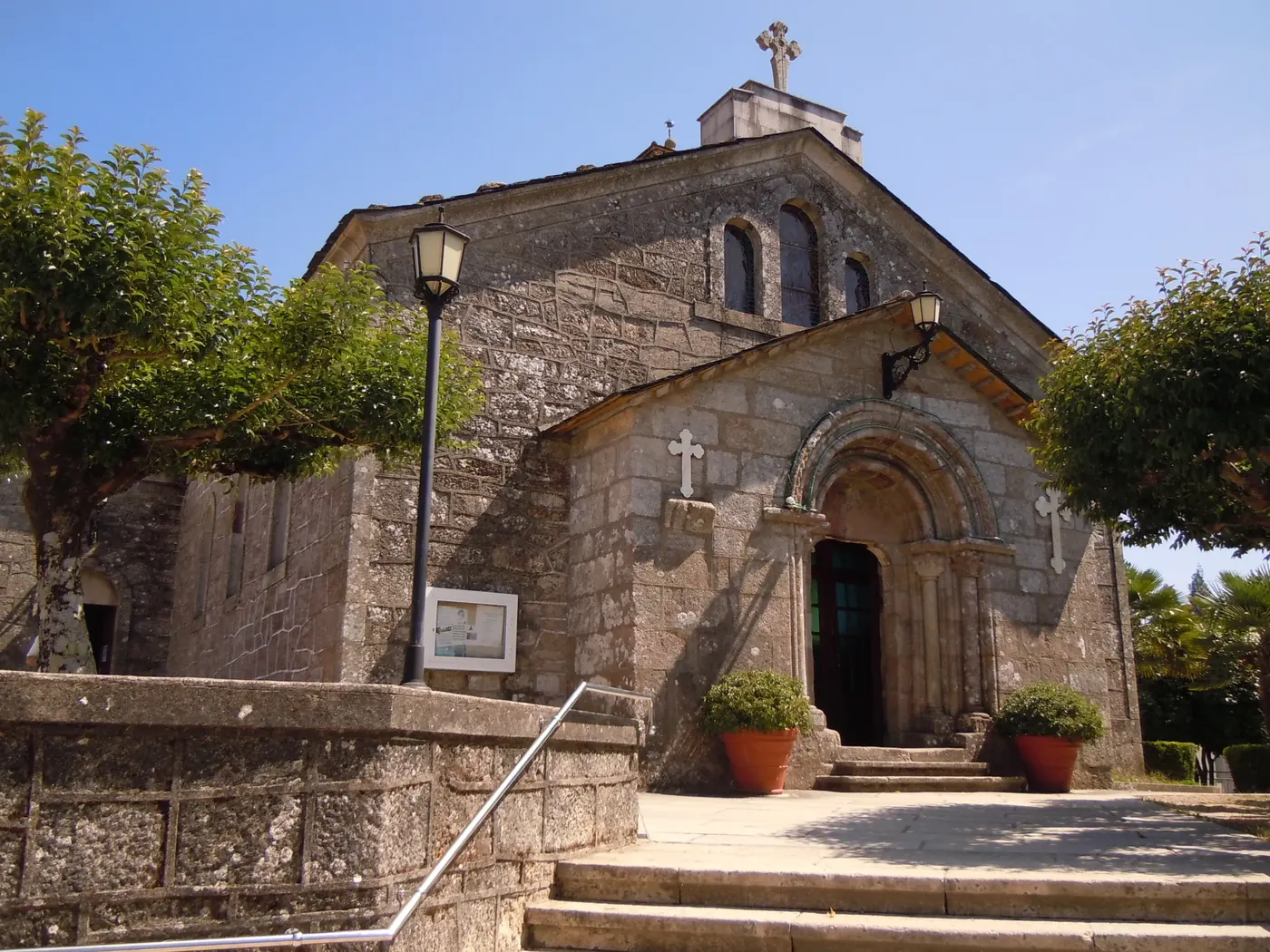
Shortly after Gonzar comes Castromaior, with its small Romanesque church of Santa María. And here is our top tip: a couple of minutes off the official route stands the castro at Castromaior, an Iron Age hill fort occupied between the 4th century BC and the 1st century AD, partly excavated and considered one of the most important archaeological sites in the north-west of the Iberian Peninsula.
The turning is signposted, it takes 10-15 minutes there and back, and from the top a huge view opens out over the surrounding countryside. The vast majority of pilgrims walk straight past without realising it is right there beside them. You no longer have that excuse: it is probably the finest spot on the whole stage.
Hospital da Cruz and Ventas de Narón: the high point of the day (km 11.5 – 13)
After Castromaior the Camino keeps gaining height as far as Hospital da Cruz, whose name recalls an old pilgrims' hospital, and then crosses the N-540 road — take care here. One last effort and you are in Ventas de Narón, up on the Serra de Ligonde. This is the highest point of the stage: from here on the going is kinder. A good place to refuel without rushing.
The Cruceiro de Lameiros and Ligonde (km 15 – 16.5)
As you drop down off the ridge, right beside the path, stands one of the most photographed cruceiros on the Camino Francés — the old stone wayside crosses you find all over Galicia. This one is the Cruceiro de Lameiros, carved in the 17th century, with the symbols of the Passion cut into its base. Worth a pause, and worth taking your time over the photograph.
Ligonde follows almost at once. It was an important halt in the Middle Ages — it even had a pilgrims' hospital of its own — and an old cemetery connected with those pilgrims survives to this day. Today it is a handful of houses carrying a great deal of pilgrim history.
Airexe and the closing rollercoaster (km 17.5 – 24.8)
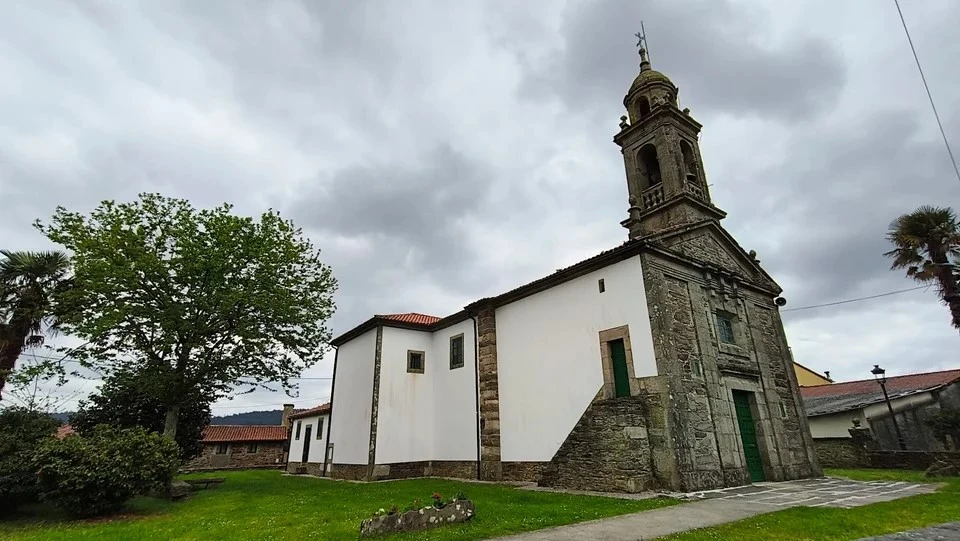
A kilometre on from Ligonde lies Airexe (signposted as Eirexe), with its church dedicated to Santiago and enough services for one final pit stop. From here it is some 7 km of one undulation after another, through hamlets such as A Brea and O Rosario — where tradition has it that pilgrims began to say the rosary once the end was in sight — before you enter Palas de Rei at the top of the town and drop down towards the centre.
Arriving in Palas de Rei: what to do once you've finished
Every afternoon Palas de Rei welcomes the pilgrims finishing their second stage out of Sarria. It is a Camino town, practical rather than monumental, and four things are worth the last hour of your day:
- The church of San Tirso. High up in the town, it still has its 12th-century Romanesque doorway. It sits right on the route of the Camino: step inside before you head down to the centre, and stamp your credencial — the pilgrim's passport — while you are there.
- A drink, taken slowly. Town life gathers along the main street and around the concello, the town hall. As evening falls the café terraces fill with pilgrims comparing blisters and stories: it is about as genuine an atmosphere as you will find in the final 100 km.
- Eat what A Ulloa produces. You are in the heart of Arzúa-Ulloa cheese country, a protected designation of origin and fine cattle-farming land. A plate of cheese with honey, or a good cut of Galician beef, is the logical reward for a 25 km day.
- Plenty of services. Palas de Rei is the main town of its district: supermarkets, a pharmacy, a health centre, cash machines, taxis and a bus connection. Everything to hand and never more than five minutes' walk away, which you'll be grateful for if you need to replace anything halfway along the Camino.
The name, by the way, is said to come from Pallatium Regis, the palace of a Visigothic king. A town with a legend for a name, to round off a stage steeped in centuries of history.
Tips for this stage
- Start a little earlier in summer. The climb up to the Serra de Ligonde feels long under a high sun; first thing in the morning it is another matter entirely.
- Water and something to eat from the off. The stretch as far as Gonzar is the least served of the whole day.
- Take the detour to the castro. We keep saying it because it works: 15 minutes that are worth the entire stage.
- If 25 km sounds like too much, there is a simple answer: split the day in two and spend the night halfway along — you'll find places to stay around Ventas de Narón, Ligonde and Airexe.
- Poles for the rollercoaster. The final section from Airexe strings together short climbs and descents with no let-up: a pair of poles spreads the effort and takes the work off your knees exactly when they will thank you for it.
Your Camino from Sarria, stage by stage
This is the second day of the Camino Francés from Sarria, the shortest itinerary that earns you the Compostela on foot (100 km; by bike it is 200). The full series:
- Stage 1: Sarria – Portomarín (22.2 km)
- Stage 2: Portomarín – Palas de Rei (24.8 km) — you are here
- Stage 3: Palas de Rei – Arzúa (28.5 km), the longest of the final section
- Stage 4: Arzúa – O Pedrouzo (19.3 km)
- Stage 5: O Pedrouzo – Santiago (19.4 km)
If you would rather arrive with everything already arranged, our Camino Francés from Sarria package (from 410 €) includes accommodation, luggage transfer, your credencial and 24/7 support — looked after from this very town.
Frequently asked questions
How many kilometres is it from Portomarín to Palas de Rei? 24.8 km on the official Camino Francés route. Adding the detour to the castro at Castromaior puts barely another half a kilometre on the day.
Is the Portomarín – Palas de Rei stage difficult? Moderate: the climb to the Serra de Ligonde takes up the first half and the closing section is rolling. Anyone reasonably used to walking will finish it without trouble in 6-7 hours including stops.
Where can you stop to eat or rest on this stage? The usual stops are Gonzar (km 8), Ventas de Narón (km 13) and Airexe (km 17.5). There is very little between Portomarín and Gonzar, so plan your breakfast before you set off.
Is the detour to the castro at Castromaior worth it? Very much so: it is one of the most thoroughly studied castros in the north-west, it is a stone's throw from the Camino and the views are among the best of the final 100 km. About 15 minutes there and back.
Can the Portomarín – Palas de Rei stage be split over two days? Yes. The usual break points are Ventas de Narón, Ligonde or Airexe, all of which have accommodation: the climb falls on the first day and the closing rollercoaster on the second, walked on fresh legs.
Planning your Camino from Sarria? Write to us and we'll organise it for you from Palas de Rei: accommodation, luggage and a local team that knows every hill on this stage.
If you would rather we took care of the logistics, have a look at our organised trip from Sarria.