
The Camino de Santiago is a tapestry woven from thousands of landscapes, each with a soul and a beauty entirely its own. Asking a pilgrim to name their favourite stage is rather like asking them to name a memory they will never lose: every answer is personal, and every answer is charged with emotion. Even so, there are certain stretches whose grandeur, whose charm or whose sheer mystical atmosphere win almost universal agreement among pilgrims. These are true jewels, the kind that stay etched in the eye and the heart of everyone who walks them. To inspire you and give you something to dream about, we have picked out 10 of the most beautiful stages on the Camino de Santiago, drawn from right across its many routes.
1. Saint-Jean-Pied-de-Port to Roncesvalles: The Epic Conquest of the Pyrenees
Route: Camino Francés
This is, without question, the queen of Camino stages. The stage from Saint-Jean-Pied-de-Port to Roncesvalles is not merely a beginning; it is a statement of intent. Climbing the Pyrenees by the Napoleon Route is a monumental physical challenge, and every backward glance repays it. The French valleys shrink beneath you as the world opens out, with deep green pastures dotted with sheep and skies that seem to have no end. The effort of the ascent peaks at the Collado de Lepoeder, where the view is simply overwhelming, before you begin the magical, mysterious descent through the beech woods that carry you down to the Colegiata de Roncesvalles.
- Why it is special: the panoramic views, the personal challenge it represents and the feeling of crossing a frontier that is both natural and historic.
2. San Vicente de la Barquera to Llanes: The Cantabrian Sea at Your Feet
Route: Camino del Norte
This stage is the beauty of the Camino del Norte distilled. Setting off from the postcard fishing town of San Vicente de la Barquera, with the Picos de Europa rising behind it, the walk to the handsome old town of Llanes is a steady procession of cliffs, golden beaches, green meadows that run straight into the sea and paths that wind along the Cantabrian shore. The sound of the waves keeps you company, the sea breeze keeps you cool, and every bend in the path reveals another cove or another spectacular viewpoint.
- Why it is special: the sublime contrast between the blue of the sea and the green of the meadows, and the majestic presence of the Picos de Europa on the horizon.
3. Villafranca del Bierzo to O Cebreiro: Galicia's Magical Doorway
Route: Camino Francés
If any stage marks a turning point, it is this one. The stage from Villafranca del Bierzo to O Cebreiro is the climb that bids farewell to the Castilian plains and welcomes you into magical Galicia. The path follows the valley of the river Valcarce before tackling the hard but glorious ascent to O Cebreiro. As you gain height the landscape changes: the woods grow denser, and the mist that so often sits on the summit adds its own air of mystery. Arriving in the pre-Roman village of O Cebreiro, with its pallozas — round dwellings of stone and thatch — feels like stepping back in time.
- Why it is special: the complete change of scenery, the beauty of the climb and the Celtic, mystical atmosphere of O Cebreiro.
4. Borres to Berducedo (via the Ruta de los Hospitales): Wild, Solitary Beauty
Route: Camino Primitivo
The Ruta de los Hospitales, the high mountain variant of the Borres–Berducedo stage, is the beating heart of the Camino Primitivo. It is one of the toughest days on any of the pilgrim routes and, at the same time, one of the most rewarding. This is high mountain walking, with no villages and no services for almost 25 km, where you meet nature at its most unfiltered. The views from the Sierra de Fonfaraón go on forever, and the ruins of the old pilgrim hospitals that give the route its name still speak of faith and survival. It is a stage that leaves you feeling very small against the sheer scale of the landscape.
- Why it is special: its wild, remote character, the 360-degree panoramas and the deep connection with the story of the medieval pilgrims.
5. Nájera to Santo Domingo de la Calzada: A Walk Through the Vineyards
Route: Camino Francés
This stage through the heart of La Rioja is a delight for the senses. The path rolls gently through a landscape given over to the 'sea of vines' for which this region is famous. The colour of the vines shifts dramatically from season to season, creating a spectacular canvas. You will pass through small stone villages before reaching Santo Domingo de la Calzada, one of the towns most steeped in Camino history, where the legend of the cockerel and the hen is still very much alive.
- Why it is special: the soothing vineyard scenery, the red earth and the historic and architectural riches waiting at the end of the day.
These jewels of the Camino are far easier to enjoy when the logistics are somebody else's problem. At OurWay we design tailor-made routes built around these unforgettable stages, booking the best accommodation so that your only job is to walk and marvel at the landscape. We take care of everything else, so all you have to do is soak up the magic.
6. Baiona to Vigo: The Rías Baixas from Above
Route: Camino Portugués Coastal Route
Entering Galicia along the Portuguese coast brings stages of a very particular beauty. The day's walk from historic Baiona to lively Vigo combines urban stretches with coastal paths and, above all, spectacular viewpoints over the Ría de Vigo. The route climbs into the hills, opening up a high, wide view of the beaches, the eucalyptus woods and the Islas Cíes beyond. It is a stage that shows how neatly seafaring Galicia and wooded Galicia fit together.
- Why it is special: the striking views over the Ría de Vigo, the scent of salt and eucalyptus, and the beauty of the beaches of the Val Miñor.
7. Lugo to Melide: Roman History and a Taste of Octopus
Route: Camino Primitivo
Beginning the day up on the Roman walls of Lugo, a UNESCO World Heritage Site, is a privilege. This stage of the Camino Primitivo, which most pilgrims split over two days, takes you deep into the most rural and authentic Galicia, along corredoiras — old country lanes — and through hamlets with centuries-old hórreos, the raised granaries of the region. Your destination, Melide, is where the route joins the Camino Francés, and it is famous for having some of the finest pulperías in all of Galicia. It is a stage that pairs a monumental start with an unforgettable finish at the table.
- Why it is special: the sheer scale of the walls of Lugo, the charm of rural Galicia and the reward of an outstanding plate of pulpo á feira, Galician-style octopus.
8. Frómista to Carrión de los Condes: The Endless Beauty of the Meseta
Route: Camino Francés
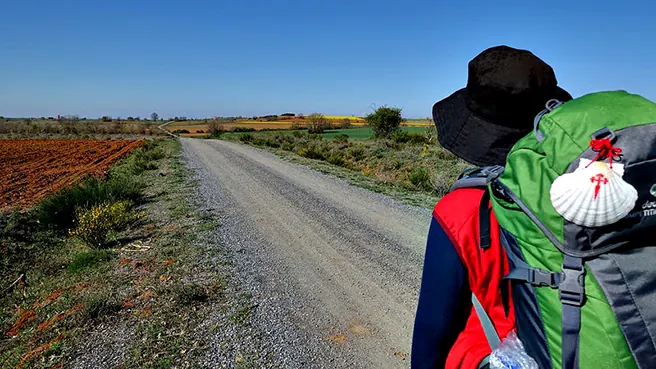
The Meseta — the high Castilian plain — is loved and dreaded in equal measure, but this stage from Frómista to Carrión de los Condes is proof of its austere, powerful beauty. The path runs dead straight towards the horizon, following the track that links Población de Campos and Villalcázar de Sirga. The lack of any real gradient and the sheer immensity of the landscape invite meditation and introspection. Sunrises and sunsets here, with the light pouring extraordinary colours over the crops, are a spectacle every pilgrim should see at least once.
- Why it is special: the feeling of peace and vastness, the spectacular skies and a rare chance for meditation on the move.
9. Olveiroa to Fisterra: The Walk to the End of the World
Route: Camino de Fisterra
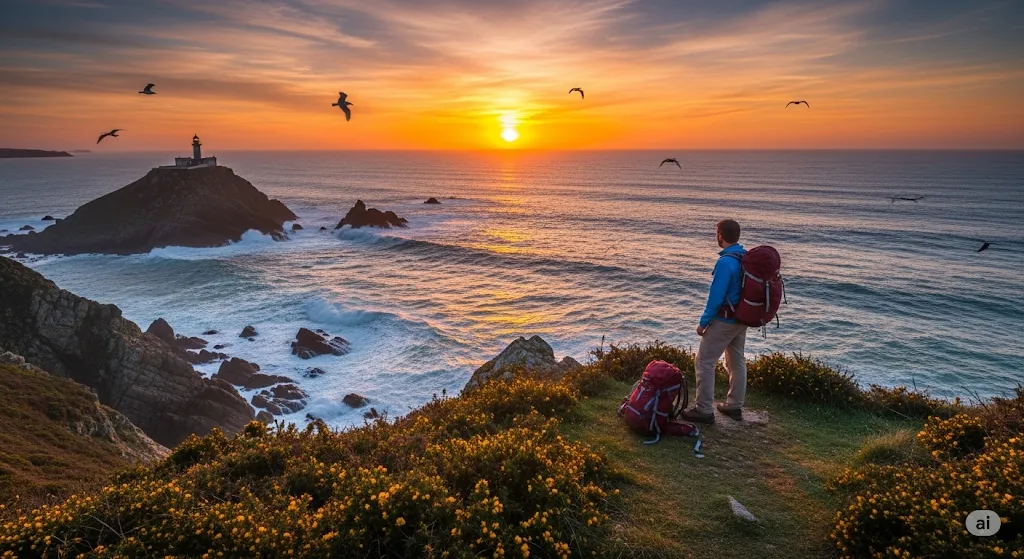
Having reached Santiago de Compostela, many pilgrims feel the pull of carrying on to the place where the Romans believed the world came to an end. The stage from Olveiroa to Fisterra is where that longing is finally answered. The moment when you crest a hill and the immensity of the Atlantic Ocean and Cabo Finisterre appear for the first time is one of the most moving of the entire journey. Arriving on Langosteira beach and then climbing up to the lighthouse for sunset is the perfect epilogue to any pilgrimage.
- Why it is special: the thrill of seeing the ocean for the first time, the symbolism of reaching the 'end of the world' and the ritual of sunset at the lighthouse.
10. Zamora to Montamarta: The Eloquent Solitude of the Vía de la Plata
Route: Vía de la Plata
The stage that leaves the Romanesque jewel of Zamora takes you into the singular landscapes of the Vía de la Plata. This is a route of solitude and wide horizons, where the cereal plains of the Tierra del Pan open out into views that seem to have no end. It is the beauty of Spain's emptied interior: a path for listening to your own thoughts and enjoying a stillness that is hard to come by on the busier routes. The silence here is not emptiness — it is full of history.
- Why it is special: the Romanesque heritage of Zamora, the sense of peace and solitude, and the distinctive landscapes of the Castilian dehesa — open oak pastureland.
Any one of these 10 stages could be the heart of your next Camino: at OurWay we design routes that include them, with accommodation booked in advance and luggage transfer.
Plan your tripFrequently asked questions
What is the most beautiful stage of the Camino de Santiago? There isn't just one, but three appear on almost every list: the crossing of the Pyrenees between Saint-Jean-Pied-de-Port and Roncesvalles, the climb to O Cebreiro from Villafranca del Bierzo and the Ruta de los Hospitales on the Camino Primitivo. If you prefer the sea to the mountains, the Cantabrian stretch from San Vicente de la Barquera to Llanes is in the same league. A point almost nobody mentions: much of that beauty is a matter of light, so set off early, because the same kilometres at midday in the heat look nothing alike.
What is the hardest stage of the Camino de Santiago? For most pilgrims, the Ruta de los Hospitales between Borres and Berducedo, on the Camino Primitivo: it strings together some 25 kilometres of open hillside with no villages, fountains or bars. Next come the first stage of the Camino Francés over the Pyrenees and the climb to O Cebreiro. The real difficulty lies less in the climbing than in the lack of services and the fog, so set out with water and food for the whole day and remember there is an alternative via Pola de Allande if the weather closes in.
Can you walk just some stages of the Camino de Santiago without doing the whole route? Yes, and it is a very common way to walk it. The Camino can be done in sections over separate trips, because the credencial doesn't expire and you can keep stamping it year after year until you complete the route. The only condition comes in if you want the Compostela: those final kilometres must be walked without skipping any section and must end in Santiago, so a single stage of the Norte or the Vía de la Plata adds scenery and experience, but not a certificate.
How many kilometres do you have to cover to get the Compostela? One hundred kilometres on foot or two hundred by bike, always ending in Santiago and with your credencial stamped along the way. From Sarria, the most popular starting point, the Pilgrim's Office asks for two stamps a day instead of one, so it is worth getting stamped at the breakfast bar or the church too, not just at your accommodation. If you'd rather not deal with bookings or your backpack, OurWay's trip from Sarria is available from 410 € per person.
What is the best time of year to walk the Camino de Santiago? May, June and September: mild temperatures, long days and far fewer crowds than in August. For the mountain stages this matters more than it seems, because O Cebreiro and the Ruta de los Hospitales can wake up to snow or thick fog between November and April, while the coastal stretches of the Norte and the Portugués are perfectly enjoyable in high summer. If you can only travel in July or August, set off early every day and book your accommodation well in advance.
If you want to walk any of these stages in a special year, make a note of 2027: it is a Holy Year, with the Holy Door open and the Camino at its busiest.
If you would rather we took care of the logistics, have a look at our organised trips from Sarria and from Tui.